MISSION DATE: JANUARY 31, 1944
MISSION NBR. 20
TARGET: Aviano, Italy - Airdrome
I. CHRONOLOGY
Thirty-three B-24's took off at 0906 hours to bomb Aviano Airdrome. Five returned early. Twenty-seven dropped 78.75 tons of 500 G.P. bombs on target at 1301 hours from 24,500 feet. One jettisoned 1 ton in Adriatic Sea due to malfunction of bomb release mechanism. Twenty-seven returned to base at 1510 hours. One landed at friendly field.
II. ROUTE AND ASSAULT
Rendezvoused with the 449th Bomb Group at 1022 hours above Manduria, with escort at 1112 hours at 8,000 feet above Lake Varano, thence as briefed to I.P. where a left turn was made onto the target. Left rally was made onto course direct to Lake Varano thence to home base.
III. RESULTS
Bomb strike photos showed hangers, administration buildings and installations at the airdrome were well covered. The southwest part of the landing ground was hit approximately 30 bombs. Two aircraft were destroyed on the ground and one aircraft probably destroyed.
IV. ENEMY RESISTANCE
A. Fighters: There were four attacks made in all by five or six enemy aircraft. Each attack being made singly without any apparent coordination. They were made over the target area and did not last longer than 4 to 5 minutes. They were not aggressive. The first attacks were made out of the sun at 5 o'clock high and the last at 9 o'clock high. Credit must be given the escort for keeping the number of attacks to a minimum. Our claims during this engagement are as follows: Destroyed – Two ME-109's, Damaged – One ME-109.
B. Flak: Over the target, it was heavy, medium to intense and accurate apparently of the predicted variety. The puffs were mostly black, interspersed with some white. The accuracy during the entire encounter was excellent. Eight of our aircraft where holed. No positive evasive action was taken by the formation.
V. OBSERVATIONS
At 1303 hours from an altitude of 24,500 feet a white balloon was seen released. At once, an FW-190, which was cruising 2,000 feet above the formation, released a large number of what appeared to be shiny disks, which glittered in the sunshine with the evident intent of making our aircraft break formation to avoid contact with these disks.
VI. CASUALTIES
Eight aircraft received minor damage from flak.
VII. FLIGHT LEADERS:
Davis Kingsman Miller Richman
450TH BOMBARDMENT GROUP (H) A. P. O. 520, U. S. ARMY
1 February 1944
Special Narrative Report No. 20.
MISSION: 31 January 1944 - Aviano A/D.
I. CHRONOLOGY
33 B-24's took off at 0906 hours to bomb Aviano A/D. 5 returned early. 27 dropped 78.75 tons of 500# (.10-.025) G.P. bombs on target at 1301 hours from 24,500'. 1 jettisoned one ton in Adriatic due to malfunction of bomb release mechanism. 27 returned to base at 1510 hours. 1 landed at friendly field. Of the 5 that returned early, 4 brought their bombs back while 1 jettisoned 3 tons in the Adriatic off Bari.
II. ROUTE AND ASSAULT
Rendezvoused with the 449th Bombardment Group (H) at 10232 hours above Manduria, with escort at 1112 hours at 8,000' above Lake Varano, thence as briefed to I. P. (Sou Veto El Tag) where left turn was made onto target which was attacked on axis of 3040. Left rally was made onto course direct to Lake Varano, thence to home base.
III. RESULTS
The 450th Bombardment Group was assigned hangars, administration buildings and installations at the A/d and bomb strike photos show the entire area well-covered. Administration buildings were hit as well as the north hangar. The South-West part of the landing ground was hit by approximately 30 bombs. Two A/C were destroyed on the ground and the photos show one A/C probably destroyed. The results could be classified as good.
IV. ENEMY RESISTENCE
A. FIGHTERS. There were four attacks made in all by five or six E/A, each attack being made singly without any apparent coordination. They were made over the target area and did not last longer than 4-5 minutes. They were not aggressive. The first attacks were made out of the sun at 5 o'clock high and the last at 9 o'clock high. The break-off was made at about 250 yards with a half-roll and dive. Credit must be given the escort for keeping the number of attacks to a minimum for reports showed an undisclosed number of enemy fighters so engaged. Our claims during this engagement are as follows: Destroyed, 2 ME-109's, damaged, 1 ME-109.
B. FLAK. Flad was first encountered as the formation swept over the town of Roveredo in Piano where a few burst were noted. Over the target, it was heavy, medium to intense and accurate – apparently of the predicted variety. Ground flashes seen at the north-east perimeter of the airdrome apparently were from 12 guns while at 46003'N-12030'E showed the location of eight guns. The puffs were mostly black, interspersed with some white. Flashes were seen from an area just N/E of administration building, believed to be a six-gun battery, while those from the dispersal area N/W of hangar were from a 4-Gun battery. The accuracy during the entire encounter was excellent. Eight of our A/C were holed. No positive evasive action was taken by the formation.
V. SIGNIFICANT OBSERVATIONS
A. GROUND. At 1303 hours from an altitude of 24,500', a white balloon was seen released from 46004'N-12030'E. At once an E/P, a FW-190, which was cruising 2,000' above the formation released a large number of what appeared to be shiny disks, which glittered in the sunshine with the evident intent of making our A/C break formation to avoid contact with the disks.
B. FLAK. From a mean altitude of 24,500' the following gun positions have been pinpointed : 8-Gun Battery – 46003'N-12030'E.
C. NAVAL. Six seaplanes were seen at 1326 hours from 18,000' at 44053'N-13048'E. At this same location at 1145 hours from 16,000', two large and two medium size vessels were seen tied at anchor. They are believed to be naval vessels or merchantmen. At 1325 hours from 18,200', one large vessel and twenty small vessels were observed at 44052'N-13050'E.
VI. CONCLUSION:
A. TOTAL LOSSES:
FROM FLAK 0
FROM FIGHTERS 0
OTHER REASONS 0
B. DAMAGE:
FROM FLAK 8 Minor
FROM FIGHTERS 0
OTHER REASONS 1 (This A/C is still at friendly A/D and no evaluation of
damage is possible at this time)
C. CASUALTIES:
FROM FLAK
KILLED 0
WOUNDED 0
FROM FIGHTERS
KILLED 0
WOUNDED 0
D. VICTORIES:
DESTROYED PROBABLY DAMAGED DAMAGED
2 0 1
E. Correction on telephone mission report not included above: None.
James A. McKamy
Major, Air Corps
Group S-2
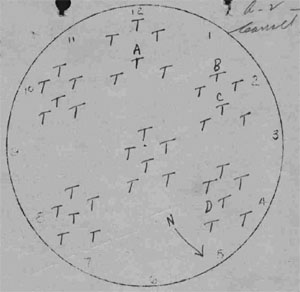
1. Lone E/A (ME-109) attacked lead A/C (A/C No. 446) ME-109's flight "A" came in high at 9 o'clock, dove down and past our A/C.
2. Lone E/A (ME-109) attacked lead A/C (A/C No. 448). ME-109's flight "B" came in high at 9 o'clock, dove down and past our A/C.
3. Lone E/A (ME-109) attacked lead A/C (A/C No. 222). ME-109's flight "C" came in low at 9 o'clock, rolling straightened out and cove away.
4. Lone E/A (ME-109) attacked left wingman (A/C No. 124). ME-109's flight "D" came in high at 9 o'clock, dove down and past our A.C.