|
A
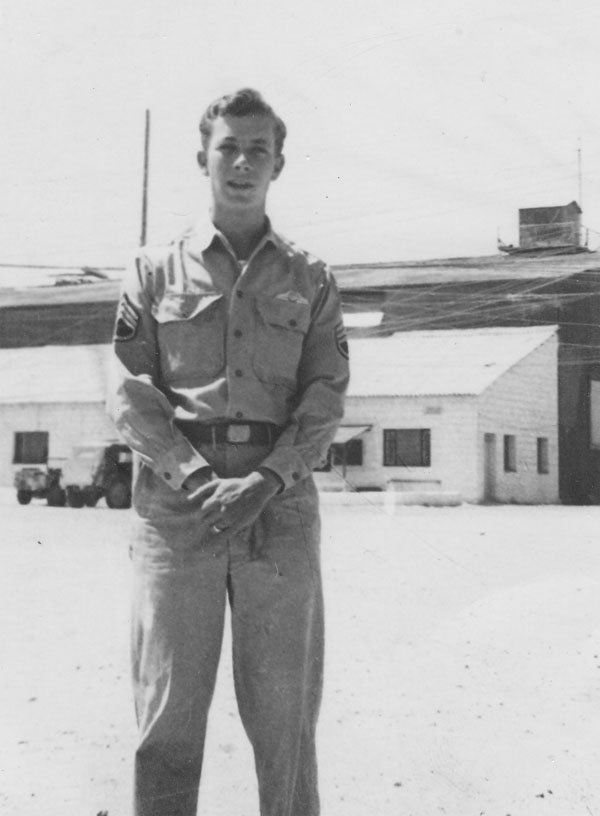
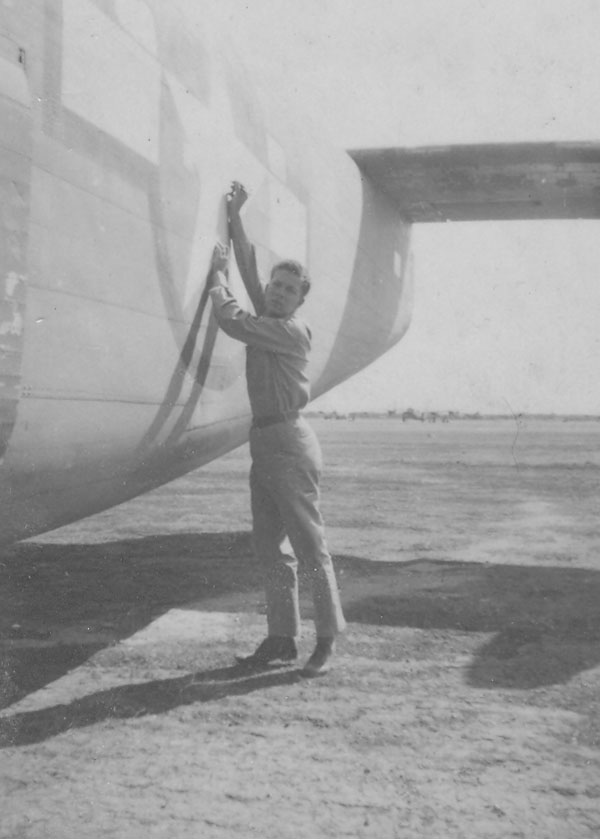
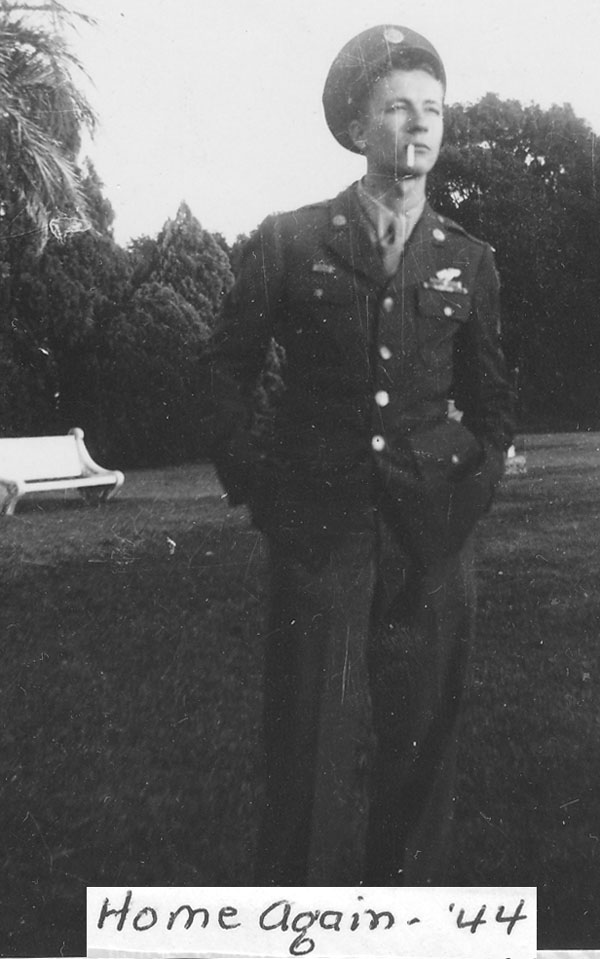
WORLD WAR II TAIL-GUNNER'S TALE
By
Henry Roger Hunter, Jr.
INTRODUCTION
The real hero of this saga is my mother who
at age 39 marched down to the Army recruiting office with me, her only son, to
sign on the dotted line which allowed me to be inducted into the service as
soon as I reached my 18th birthday. The draft age was still 21 but was soon to
be lowered to 18 later that year. It was February 1943 and the war was raging
at its fullest intensity.
Fourteen months prior to this, my father's
ship was torpedoed and sunk by a Japanese submarine in the Pacific Ocean. This
was December 18, 1941 only eleven days after Pearl Harbor. He spent ten days in
an open lifeboat before he was finally rescued. He continued serving in the
merchant marine, including convoys to northern Russia, throughout the war.
When I entered the Army Air Corps in March
1943, my mother was left in a strange land with two young daughters ages 10 and
12. With my father's power-of-attorney she sold our home and other possessions,
packed up and drove the family car from New Orleans, Louisiana to Virginia Beach, Virginia which was her hometown. Even though I was born in New Orleans, we were always like strangers looking in. Looking back at these events, it is
hard to imagine her fortitude ... she never let me see her shed a tear except
when we both came home and the war was over.
YOU'RE IN THE ARMY NOW
After signing up I was told to report to
New Orleans Custom House where I was to receive a physical exam before I was
finally accepted. The 40 or 50 of us expectant inductees, who had reported at
the same time, were given cover-up towels and told to strip. We were seated in
cold folding chairs around the large room and a group of young doctors with
their stethoscopes hurriedly marched around the room checking temperatures,
heartbeats and reflexes. The only question asked of me was "do your flat
feet give you any trouble?" I answered "no" and that was the end
of my exam. Only a couple of the potential recruits were rejected. The rest of
us were sworn in and told to take a general classification test and then to go
home and wait for written instructions in the mail.
Within a few days instructions were
received telling me what to bring, what not to bring, date and time of
departure and where to report. On March 15, 1943 (four days before my 18th birthday) I was chugging out of town on the most decrepit troop train I had ever
seen. It must have been a World War I relic. The engine was a coal burner and
the cars looked older than New Orleans streetcars. Naturally, we were all
soot-covered messes when we reached San Antonio. Upon arrival we were assigned
barracks, issued uniforms, given GI haircuts and ID numbers. 18138308 is
permanently etched on my brain.
PREFLIGHT SCHOOL ... TORTURE AND FUN
This is what we came here for. We all
wanted to become Air Corps Pilots, preferably fighter pilots. However, becoming
a bomber pilot would be OK too. Preflight school was tough. It was like super
boot camp combined with college crunch non-stop. The whole school lasted only
nine weeks during which time you were not only whipped into physical shape, but
also had to conquer academics included in the Army manual, such as aircraft
identification, naval vessel identification,
Morse code, etc.
The first four and a half weeks we were
underclassmen who had to heed any and all instructions issued by the
upperclassmen. We were not allowed to walk but were required to run to and from
all classroom or physical training sessions. Also "white glove"
inspections were the order of the day. We were given demerits
("gigged") for any and all infractions. Even in the mess hall we were
required to sit at rigid attention and eat "square meals." When ice
cream was served for dessert we had to get permission to make a sundae with the
preserves on the table unless it was on a Sunday.
Next came the "Fun" part. At
last, our tormentors moved onto primary flight training and then for the next
four and a half weeks we were in the driver's seat when the new recruits moved
in and we became the upperclassmen. I studied and worked very hard and
completed preflight training in the top 10 percent of my class. Of course, I
was anxious to begin primary flight training.
PRIMARY FLIGHT TRAINING ... A DISAPPOINTMENT
At age 18, I thought I could compete with
anyone at any task I so chose. Academically I did OK but I am certain that my
flying ability left much to be desired. I had never flown before. The blue and
yellow PT 19 was a neat little plane that was considered easy to fly.
When my civilian instructor climbed out of
the cockpit while we were doing practice landings and told me to take it up I
was pretty nervous. I took off and flew the proper pattern but my solo landing
was horrible. I bounced around a couple of times and almost winged over. I got
somewhat better as time went by but apparently not good enough.
After about six weeks I got the bad news
that I had "washed out." Also, about 80 percent of my class got the
same news. Nearly all of those who advanced to basic flight training had been
pilots in civilian life. "Lack of coordination" was the main
disclaimer given to those of us who washed out. This was probably true in my
case but a cadet named Jones who could do back and front flips and make his
accordion sing was also eliminated because of lack of coordination.
I was later told that the pilot training
program had been saturated but that bomber gunners were sorely needed so I
volunteered for gunnery school. A group of us went to Tyndal Field, Panama City, Florida for our training. At least I would still be flying.
GUNNERY SCHOOL
... A GOOD EXPERIENCE
Tyndal Field was a well-run base in my
estimation. It was not too tough, but strict enough to ensure proper
discipline. Compared to cadet military training Tyndal was easy. When we
arrived, all of the "washed out" cadets were assigned to one of the
four barracks which housed our gunnery class. This was a big mistake because
this barracks always won the weekly inspections which earned the winners
weekend passes to the Panama City area. I went to town a couple of times and
recognized the fact that the area was very overcrowded with G.I.s. Once I
visited Apalachicola which in 1943 was a quaint little fishing town.
Classroom training included aircraft
identification, naval vessel identification, various weapons which we were
required to field strip, trouble-shoot, assemble and prepare for use on firing
ranges. Various aircraft gun sights were a must to learn. Sperry was the only
self-computing sight in use at that time. When I took the night vision test,
which requires several hours in a completely dark room, my grade was much
better than average so I had to retake it twice again just to double check that
my first grade was authentic. My hopes were high when I heard that night
fighter gunners were needed for the new Northrop P-61 Black Widow night fighter
which carried a rear gunner. However, I never heard any more about this.
Probably all of the slots were filled with experienced gunners.
On the firing range we were required to
qualify with various weapons but main emphasis was placed on air cooled caliber
30 and caliber 50 machine guns. We did a little air-to-air target shooting from
the waist position of an ancient twin engine Lockheed Hudson or Ventura. I believe that the target tow planes were AT6s with a tow sock very much like
advertisements towed by small planes today. The tow plane flew by at close
range like a "sitting duck." Those pilots were very brave men who
should have received combat pay. The Waller Trainer, a gunnery simulator, was
most useful in teaching you how to properly lead approaching aircraft from
various angles. The screen was 3-D and was the forerunner of 3-D movies seen
immediately after the war.
When I completed gunnery school, I was
awarded my Air Crew Member wings, a couple of appropriate badges for qualifying
on the firing range and my PFC stripes. I shipped out and with some usual
delays I arrived at the Salt Lake City Air Base.
AIR CREW TRAINING
Hundreds of anxious trainees were
assembled at the Salt Lake City Army Air Base. Roll call and mail call
formations were the order of the day. We were just a sea of faces looking up at
the speaker on a platform. If you volunteered for specific duty as it was
called out, you would earn a day pass to town. When two butchers were needed,
the young man standing next to me gave me a nudge and said, "Come on, it's
easy. I was a butcher in civilian life and I will show you how." I
stupidly raised my hand and we were ushered away by a corporal. My friend and I
were sent to separate mess halls. Thank goodness for the meat cutting charts on
the wall. I cut up whatever I could and ground the rest. Needless to say, there
was an abundance of ground beef. However, I did get my pass and enjoyed my day
in Salt Lake City. Those people really know the meaning of hospitality.
On about the third day we were assigned to
crews of ten for B-24 Liberator training. My crew members were Lt. Norbert
Bertling ... pilot, Lt. Walter Fahnstock ... co-pilot, Lt. Tautfest ...
navigator, Lt. Frank Cupo . . . bombardier, Sgt. John Reid ... ball turret
gunner, Sgt. Harvey R. Houston ... armorer and waist gunner, Sgt. August
"Dutch" Regier ... assistant engineer and nose turret gunner, Sgt.
Fred Collins ... radio operator and waist gunner, and our flight engineer who I
will not name as will be explained in a later episode.
It was the dead of winter 1943 and our training
group was shipped off to Wendover, Utah. As we marched onto the base, the
previous training group was leaving. All we heard were cat calls and
"you'll be sorry!" from the departers. The TV series Northern
Exposure had nothing on this base. Our barracks were tar-paper covered and
heated by pot-bellied stoves with bins of coal used to stoke the stoves. If
your bunk was near the stove you roasted, but a few feet away you were
freezing. A heavy snow fell our first night there and it was necessary to crawl
out of a window until the snow could be shoveled away.
The foul weather made it impossible to fly
so our CO decided to keep us busy on the range qualifying with the 45 handgun
and Thompson submachine gun. It was so cold that you couldn't even feel the
weapon in your hand. This went on for several days and suddenly a miracle took
place ... we were to be shipped out to another base. March Field, Riverside, California, was a welcome sight even though as we arrived in "sunny California" it was raining so hard that you couldn't see a foot in front of your face.
Naturally our CO decided that we should make a good impression by marching onto
the base in our Class A uniforms. I don't even remember his name but I hope
that he will forgive me for these unmilitary-like remarks.
Our training was fun. We went through all
of the routine of practice flight, bombing runs, gunnery and navigation. At
first I was assigned the ball turret position, but Lt. Bertling asked Sgt. Reid
and me to swap positions because he was smaller and fit the crowded ball turret
better. That stroke of fate made me tail gunner. We were fortunate to have an
experienced combat veteran navigator. Lt. Tautfest was promoted to the rank of
Captain before we left March Field. Also, our crew was selected as the model
crew of our training group.
However, the grim reality of sudden death
is always present when training green airmen. A Liberator from another base was
granted emergency landing because an outboard engine was out and the propeller
was feathered. This would have been routine for an experienced pilot, but the
training pilot came in a little too slowly with flaps down and banked on the
dead engine to better line up with the runaway ... a fatal mistake! The plane
crashed near the end of the runway and burst into flames. I was told that one
airman in the rear of the plane survived. In another incident, one of our base
pilots was practicing instrument take off and landing along with a qualified
instructor. They took off in a normal fashion then nosed the plane down and
flew it into the ground beyond the end of the runway. Both of these pilots were
killed.
Weekend passes were welcomed while at March
Field. Transportation was excellent to Los Angeles and Hollywood. I really
enjoyed the Brown Derby and Hollywood Canteen ... saw Katherine Hepburn and
Donald O'Connor in person. Dutch Regier was married and lived in Los Angeles. Every Monday he came back to the base with a hangover and we had to prop him
up at briefing before take-off. One Monday we even dressed him in his flight
togs, undressed him when we landed and then put him to bed in the barracks ...
he never even knew the difference.
OUR FLIGHT OVERSEAS
Our first stop was the San Francisco Air
Base where we were issued new flight togs, boots, watches and 45 caliber side
arms. Next we were issued a brand new shiny B-24 and our overseas orders. Up
until the last minute we didn't know if we were going to Europe or the Pacific.
After take-off, Lt. Bertling let us know that Europe and the 15th Air Force was
our destination.
The first stop on our journey was Memphis, Tennessee. Just as we were landing a sudden violent storm bombarded our plane.
Much damage was done to the control surfaces by golf ball-size hail.
Consequently, we had to wait about two weeks for parts and repairs. Meanwhile
several of us noncoms made friends with the base supply sergeant who showed us
around Memphis. He was very friendly and the city was nice. Before we left, he
offered us some used bunk bed mattresses and covers. We each took one and lined
the rear end of the plane behind the bomb bay.
Our second stop was Cuba where we only spent the night and were not able to leave the base. Next morning we
were on our way to Natal, Brazil. The trip there was memorable. We hedgehopped
over the mouth of the Amazon River which was at flood stage. The jungle there
was dense and beautiful and we stampeded several; small herds of water buffalo.
The base at Natal was primitive and Natal itself was typical
south-of-the-border ... working for the Yankee dollar. We all went to town, ate
a good meal and bought brown gaucho uniform boots for $25 a pair.
Our next destination was Dakar, French West Africa. As soon as we reached proper altitude, Capt. Tautfest set our course
and we were flying on automatic pilot. The officers all sacked out on our
acquired bunk mattresses and we noncoms took turns at the pilot and co-pilot
positions. It took us exactly eleven hours and twenty minutes to make the
crossing and we let Lt. Bertling know as soon as we crossed into Africa. We were right on course. The base at Dakar was a strange place. The guards there
were very tall, with shiny black skin, and wore short pants and had fixed
bayonets on very long rifles. Altogether, guards, rifles and bayonets were
about eight feet tall. As soon as we touched down, the G.I.s who greeted us
wanted to buy our boots for $100 ... had we only known we could have made a
bundle.
Next we flew to Tunis, Tunisia in North Africa. We had been briefed in jungle survival in Dakar in case we had problems
between there and Tunisia. The jungles were heavy and we were told that some of
the natives were none too friendly. The Arabs in Tunis didn't seem to be too
happy about our presence either. I later learned that Nazi occupation had made
them wary. We went to a night club in Tunis which was pretty rough. Mostly
soldiers from allied countries were there trying to drown their problems. It
was similar to the bar room scene in the movie "Star Wars" with all
the different uniforms and languages. We managed to survive this ordeal and
departed the next day for our final destination.
The base at Manduria, Italy was primitive and very run down. It was to be our home and new base of the 450th Heavy Bomb
Group of the 15th Air Force.
MANDURIA, ITALY
(1943 - 1944)
The population of Manduria was
approximately 20,000 ... mostly peasants who worked in adjoining vineyards. The
buildings were built primarily of native limestone with very little wood. The
streets were so narrow that two vehicles could hardly pass. There were a town
square, an open marketplace and a well in the center of town. I didn't see any
running water and very few buildings had electricity.
I made friends with the town electrician,
his wife and five-year-old daughter, Melina. They all spoke some English which
was very convenient. His wife did my laundry and I ate a home cooked meal with
them about once a week. No money ever exchanged hands. I kept them supplied
with luxuries such as candy, gum, soap, cigarettes and other goodies. Real eggs
were brought back to the base which we ate at the mess hall in lieu of the
powdered ones furnished by Uncle Sam.
Their home was a two-story limestone with a
dirt lower floor. All meals were prepared in a large iron pot which hung in the
fireplace. They had electricity, but only for lighting. At night their milk
goat and chickens were ushered in downstairs and bedrooms were upstairs. Some
country folk in the area lived in peculiar igloo-shaped limestone structures.
The feudal lord who owned most of the surrounding land lived in an old,
well-preserved castle which I visited once while there.
450TH HEAVY BOMB GROUP, 15TH ARMY AIR FORCE, MANDURIA, ITALY
Upon arrival we were well greeted and
briefed on base functions. Officers and enlisted men were assigned separate
barracks, all of which were in terrible shape. The bunks were wooden
double-decker with canvas bottoms. Only GI blankets were issued and there were
no mattresses. We didn't realize what a gold mine we had in the rear of our
plane! With our real mattresses we were the envy of the barracks. We all
"willed" ours to other gunners in the barracks in case we didn't make
it back from a mission.
We had running cold water only in our large
restroom which had shower stalls and squat toilets against the rear wall, a
single latrine trough against one side wall and a lavatory trough against the
other side wall. Some ingenious inventor had devised a hot water heater with
copper coils and a drip pan for 100 octane aircraft fuel which when lit heated
the water going through the coils to one of the shower stalls. Shortly after we
arrived, some enterprising G.I.s showed up with an Italian barber and barber
chair. Pascal (Pat) set up business in our restroom charging 10L for a shave
and 10L for a haircut. He lived in town but got to eat in our mess hall.
Eventually, Pat and his barber chair were moved to more practical quarters when
a base club was completed. This kept everyone on base from parading through our
barracks all day long.
At night giant slugs came through the
cracks in the floor and crawled over everything in sight, leaving their silver
streaks behind. Fortunately the mess hall had been issued rock salt for making
ice cream. The rock salt soon remedied the slug problem.
Each plane had its own pad and ground crew.
The pads were well dispersed away from headquarters and each other to minimize
any mass destruction by enemy bombers. Junker and Heinkel two-engine bombers
would fly over single file during the night at fairly low altitude and drop
their bombs. A couple of times they tore up the runway but never hit any of our
planes while I was there. When the air raid siren blew it was lights out but
there was no interruption of blackjack or poker games in progress. Lights were
strung up under upper bunks and the lower bunks were draped with blankets. I
guess we were in the wrong Air Force because we didn't have any aircraft pads
next to headquarters or dance clubs like in the movie Memphis Belle. In fact,
we never even wore class-A uniforms or had any dances ... too bad.
Our ground crews and maintenance personnel
were pure geniuses. How they kept those planes repaired and flying was beyond
comprehension. The B-24s were always repaired and ready to fly the next day
unless an engine change was required. Then that plane had to be test-flown
before it went on a mission. We had some weird looking planes. The old ones
were desert sand colored and the new ones were silver. All good parts were used
when making repairs which resulted in a number of patchwork planes.
Of course we gunners repaired and checked
out our own equipment before and after each flight. I always replaced my gun
barrels if they were used at all during the mission. Crew members checked and
rechecked their equipment before and after each mission.
Briefing for each mission flown was held in
a hangar with a large map of Europe in the background. The exact route was
taped starting at our base and ending at the target for the day. The initial
point and bomb runs were plotted in detail and the exact target was outlined on
the map. Briefing was usually about 4:30 A.M. and everything was hush-hush. We
went straight to our planes and were airborne without contact with anyone else.
We were told to maintain radio silence until we were returning to base. As soon
as we grouped and headed for the Adriatic or the Mediterranean, the German
radio would come on and tell us our target details and even who was leading the
Group for the day ... so much for secrecy.
Before we could fly as a crew, Lt. Bertling
was required to fly a couple of missions as copilot with an experienced crew.
Unfortunately, he suffered a fatal wound and the rest of us were used as
replacements where needed. The only original crew member that I ever flew with
was our co-pilot, Lt. Fahnstock who subsequently was wounded and returned to
the United States. I never saw or heard from him again. I especially remember
him for his ready smile and witty remarks. The first time that he climbed into
a B-24 cockpit at March Field he remarked, "This is like sitting in your
living room and flying the house." Just think of how tiny the B-24 was compared
to some of today's aircraft.
Lt. Cupo, our bombardier, was the most
friendly of our officers. Even though we were not flying together he would
occasionally visit with us at our barracks. When he was grounded after
surviving two bad crackups, including one ditching, he told us that he was
going back to the States and wished us well.
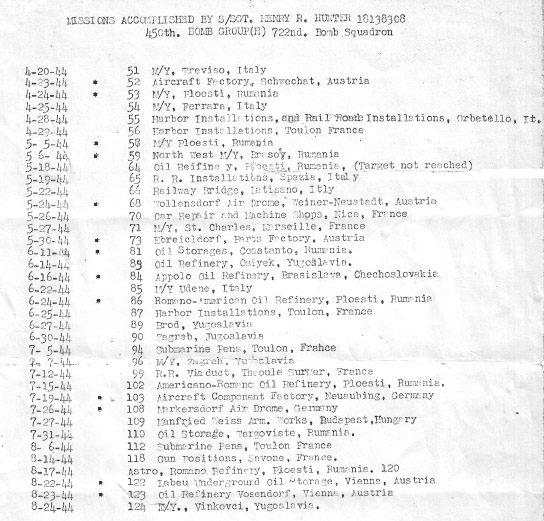
I flew my first mission as replacement for
a tail gunner who was wounded. This was mission No. 51 flown by the 450th Bomb
Group. The target was a martialing yard in Treviso, Italy. I didn't know that
this was a "milk run." The few Italian fighters didn't even come into
range and the ackack wasn't close. My complacency was short-lived because my
second mission was an aircraft factory in Schwechat, Austria and third was a
martialing yard in Ploesti, Rumania. The flack was so heavy that it looked as
though you could walk on it like Jesus walked on water. Your plane would
shutter and shake and shrapnel piercing the fuselage and wings sounded like
hail on a tin roof. The puffs of black smoke were everywhere. Waist gunners
threw large packs of shiny tinsel out of the open side windows where their
machine guns were mounted to help confuse enemy radar which controlled
antiaircraft fire. Planes would land after a mission with large sections shot
away. It was unbelievable that some of them made it back at all.
The antiaircraft fire was bad enough, but
enemy fighters actually took the greatest toll. The Messerschmit (M.E. 109) and
Fock Wolfe (F. W. 190) were the mainstay of the German fighter force. They were
excellent aircraft and their pilots knew their business. Deep penetrations into
enemy territory would bring out their fighters like hornets. Often we would be
briefed on one hundred enemy aircraft in an area and would actually meet twice
as many. Lockheed Lightning P 38 fighters were to be our escort but were
usually sorely outnumbered and also often carried bombs to the target area
themselves which rendered them nearly useless to the bomber formations. After
dropping their bombs their fuel would be depleted so they would wave their
wings at us and head for home leaving the Liberators and Flying Fortresses to
fend for themselves.
We were returning from a "milk
run" to Toulon in southern France on April 29, 1944, when one of our bombers dropped out of formation and was lagging a short distance behind. As
we rounded a thunderhead out over the Mediterranean Sea near the Anzio
Beachhead, we observed several enemy aircraft coming from under the heavy cloud
and doing battle with the straggler. It was all over within a few minutes and
the pilot radioed that they were going down. Ten parachutes were counted before
the plane disappeared from view. Two of those crew members were Sgt. Harvey R.
Houston from Elmira, New York, and Sgt. August "Dutch" Regier from Los Angeles, California, who were members of my original crew. They and the other crew
members were captured by the Germans and trey were POW's until liberated at the
end of the war.
Shortly thereafter a strange string of
incidents began to unfold. I had often heard that truth was stranger than
fiction and these incidents solidified this often quoted conjecture. Back when
I introduced my original crew members I had intentionally omitted the name of
our flight engineer. He had been assigned as flight engineer to a crew that was
shot down over Northern Italy. However, when the Group returned from the target
that day, he showed up on the base and turned himself in. He confessed to
having gone to briefing but failed to board the plane for the mission. It seems
that this routine had occurred several times. Why his pilot and crew let him
get by with such a thing, I'll never know. Within a few weeks this crew
"walked back" through enemy lines. I never learned what punishment,
if any, was meted out to that pilot but the flight engineer was reduced to the
rank of private and assigned ground crew duties. The young man was humiliated
and ostracized by flyers and ground crew members alike. He probably should have
been grounded and given treatment or at least assigned to another base. I
visited him several times before I left and he told me that I was the only
friend he had. He suffered too much for something he couldn't control.
I had flown about half of my missions as tail
gunner with several crews, only once having flown as waist gunner. That time I
checked out a camera and got some pretty good combat shots. However, after the
film was developed, I was given copies of only a few photos. I was told that
the rest of the film was classified. Finally, I was assigned permanently to a
crew as tail gunner for our squadron CO, Major McWorter. He was by far the best
pilot I ever flew with. He handled that lumbering plane with the finesse of a
fighter pilot. I believe that I would have flown to Hell and back with him and
several times it seemed as though we did. The group CO and adjutant did not
have their own crews but would borrow squadron CO's crews when they were
scheduled for a mission. From that time on, I always flew near or at the front
in the lead formation which was considered the safest spot. The other
formations flown were the high-right and low-left with a total of between forty
and forty-five aircraft on a mission by our group. We flew a pretty tight
formation and when enemy aircraft were shot down it was usually not possible to
determine which gunner actually did the damage. It didn't really matter as long
as you got back to the base. Approximately 1,200 heavy bombers flew on each
mission of the 15th Air Force.
Altogether, I flew through Brenner Pass in the Alps several times to targets in Germany with temperatures ranging as
low as 65 degrees F below zero in the un-pressurized plane. Once we skirted Lake Geneva near Switzerland's border and saw Swiss planes patrolling their territory. I
flew to targets in Ploesti, Rumania four times. Rumania was by far the most
protected area in the Balkans because it was their major oil supply. Thank the
Lord for the P-51 Mustangs and P-47 Thunderbolts that gave us cover during my
latter missions. I don't think that I would have made it without them.
I had completed about thirty missions when
the plane Fred Collins was radio operator in was shot down over Rumania or
Hungary ... I don't remember which. I wasn't on that particular mission, but
was told that all personnel had bailed out successfully. Fred was liberated
from a P.O.W. camp by the Russians and he returned to our base. He looked to be
in good shape and was in high spirits. He was sent home to West Hartford, Connecticut shortly thereafter. By the time he was liberated I had completed my tour of
duty and was waiting for orders to return to the U.S.
John Reid and I were the best of friends.
He was flying as ball turret gunner with a CO from another squadron. Whenever
either of us completed a mission, we would save the double shot of whiskey
given to us after debriefing. Our plans were to have a private celebration when
we both completed our tours of duty and we had saved up a whole quart of
Gibson's Rye. It was my forty-fifth mission and we were both scheduled to fly
that day. The Astro, Romano Refinery, Ploesti, Rumania was our target. John was
flying in the lead plane of the formation along with Capt. Tautfest who was
then Group navigator. Their pilot was the Group Adjutant. Our plane piloted by
Major McWorter was alternate lead and the 450th Bomb Group was first over the
target for the day. The group reached the initial point in good shape and
turned onto the bomb run which required straight and level flight through
intense antiaircraft fire until "bombs away." Just as "bombs
away" was announced, someone blurted out, "direct hit on the lead
plane." Instead of watching the bomb pattern as usual on the target below,
I turned my turret to the side and watched in disbelief as the lead plane
disintegrated before my eyes. No chutes were spotted and the general consensus
was that there could not have been any survivors. This conclusion was in error
because the pilot later turned up as a P.O. W. He had been blown out of the
plane and opened his chute at about five thousand feet. Lucky for him that
pilots and co-pilots wore back packs because mobility was not required for
them. The rest of us used snap-on chutes. I often practiced removing my flack
suit and helmet, grabbing my knees, rolling backward out of my turret, snapping
on my chute which was on the floor behind me and opening the rear emergency and
entrance hatch. I could do this procedure in about 30 seconds.
When we returned to the base, I was very despondent
... I had just lost my very best friend and the long hard flight had drained
me. Thank goodness I wasn't scheduled to fly the next day or I would have had
to go on sick call. I skipped supper, changed out of my flight togs, gathered
up our bottle of Gibson's Rye and went to the base outdoor movie. The movie was
a screen, projector, and bomb fin protector covers which were used for seats. I
sat on the back row and uncorked the bottle. I didn't remember anything after
that until the next afternoon when I awakened in my bunk. I still had the
bottle and it was nearly empty. I have never done anything like that before or
after ... it's a wonder it didn't kill me.
My last few missions were most difficult.
John and I had propped each other up and I had lost my prop. I was now the only
remaining flyer of my original crew of ten. I went through all the required
motions but was actually operating from habit like a robot. Two of these latter
missions were long and hard to Vienna, Austria and I hardly remembered them. My
very last mission was like my first, a "milk run" to a martialing
yard in Yugoslavia. I had actually finished my tour of duty! (50 missions). I
often ponder how differently things might have been had John and I not swapped
positions in crew training.
MISCELLANEA
I had never met John Reid's wife, but I
felt that I really knew her. John kept her photo handy by his bunk and referred
to her as his "red head." Apparently she knew that we were not flying
together so she sent me a note inquiring about John when she received a
"missing in action" notice from Uncle Sam. It broke my heart to have
to tell her not to hold out any hope for his return. This was one of the
hardest things I had ever done.
When I got back to the States, I was given
a 30-day furlough and then sent to a base in California awaiting assignment to
gunnery instructor school. Meanwhile, I was able to visit August
"Dutch" Regier's wife in Los Angeles. She was very sad and by this
time had come to the conclusion that Dutch wasn't coming back. I tried to
console her but I guess I just didn't know how. Up to that time she too had
received only an MIA notice.
Some flights lasted as long as fifteen
hours. The B-24 could fly only between 200 and 300 mph under ideal conditions.
We never flew over 22,000 feet. As mentioned previously, the cabin was not
pressurized, therefore the inside and outside temperatures were the same. On
nearly every mission it was necessary to remove my oxygen mask and beat it
against the side of the turret to get rid of ice accumulated from my breath;
otherwise, it was impossible to breathe. My flight togs included underwear,
long johns, a jump suit, a heated plug-in suit with heated gloves and boots
which often shorted out and were useless, several pair of heavy socks, GI
leather boots, a fur-lined leather jacket, fur-lined leather helmet and boots,
a steel flack suit, goggles, earphones and an oxygen mask. On top of all this
(except under the flack suit) I wore a snap-on parachute harness. We all looked
like fat teddy bears from outer space.
When 2,700 gallons of fuel was pumped it
was usually a difficult mission. 2,400 gallons was the signal for a "milk
run." One of our cameramen always determined the amount of fuel to be used
on his scheduled flights. He would trade flights with other cameramen if 2,400
gallons of fuel only was loaded aboard. He did not want to fly on any
"milk runs." He completed his tour of duty before I did but
volunteered to continue flying missions which he was still doing when I shipped
out.
Bari was a nice clean city on the Adriatic Sea. I especially enjoyed a concert in their opera house. Taranto was pretty beat
up because of the invasion of southern Italy. I visited the battleship Texas in Taranto as it was being readied for the Southern France invasion. It had been
heavily damaged at Normandy. I was not very impressed with Naples because it
was dirty and the residents were not too friendly ... maybe things were not
normal because of the war. Capri was clean enough, but I didn't feel too
welcome there either. I went to San Severo on the Adriatic Sea for a weeks
rest. It was rustic, friendly and nice. The food at the hotel was excellent
considering the conditions. Rome was nice and the Vatican was beautiful. I wish
I could have spent more than one day there. Also, Cairo, Egypt was interesting, but we flew there and back the same day. We were checking out an engine
change and picking up a little black market Seagrams Black Label for the base
club.
After completing my tour of duty, I was
sent to a tent city staging area awaiting orders to the U.S. Soon I was assigned as a guard on a converted French liner with 1000 German Officer
P.O.W.s headed for a camp in the States. My duties were simple - four hours on
and eight hours off. The prisoners did all of the work, cleaning, cooking,
K.P., etc. I held a Thompson submachine gun on my lap and talked with them.
They all spoke excellent English. Some of them were really brainwashed. They
thought that Germany would still win the war and it was unfortunate that they
had been captured.
We sailed past Gibraltar the first night
that the blackout was lifted. Much celebration was going on there. The trip
across the Atlantic was rough. The old liner apparently had no gyros and we
went through a monstrous storm. Nearly everyone aboard was seasick. It was
quite a relief when we reached the New Jersey base where our prisoners were
taken over by the local M.P.'s. I was issued a furlough and told that further
orders would be received at my home in New Orleans, Louisiana.
My next assignment was B-24 gunnery
instructors' school in Laredo, Texas, after which I was assigned to Harlingen
AAF Base, Texas which was just north of the Mexican border near Brownsville, Texas. It was not a spit and polish base but stuck to the purpose of training
aerial gunners. I was one of the first replacement instructors and was given my
choice of working on the main base or the more remote gunnery base and firing
range. I chose the gunnery base because it gave me more opportunity to fly. I
was put in charge of a training section and somehow was named barracks chief
... a dubious privilege. Rattlesnakes ran rampant on the base and would absorb
heat from the asphalt walks at night. Therefore, you never ventured out at
night without a flashlight.
Soon thereafter the war ended in Europe and B-24 training came to a sudden halt. Next I went to B-29 remote control turret
gunnery school in Fort Myers, Florida and returned to Harlingen where I
continued as a B-29 gunnery instructor. The B-29 Super Fort was pure luxury
after having flown in Liberators. This was the first pressurized heated cabin
bomber flown by the U.S. and was to be used in an all-out push to end the
Japanese war. All of the turret sights were self-computing with primary and
secondary controls at each gunnery station. Also, you could wear light
comfortable flight togs even though the plane could fly over 30,000 feet.
B-29 gunnery training was in full swing
when suddenly came the news of Hiroshima and then Nagasaki which was a blessing
to those of us who had been through the fire. Gunnery instructors expected to
be called up again for action in the Pacific if a long drawn out effort had
been required. After all, we were fully trained combat veterans. I salute you
President Harry S. Truman for having the fortitude to make your momentous
decision. It was a great decision if a quarter million or only one U.S. service man's life was saved.
I salute Lt. Bertling, Capt. Tautfest, Sgt.
Regier, Sgt. Houston, and Sgt. Reid who gave their all for our country and its
people. My heart goes out to their families and the families of the many
thousands of our servicemen who lost their lives during W.W. II and subsequent
conflicts.
Honorable Discharge - September 12, 1945
|