|
|
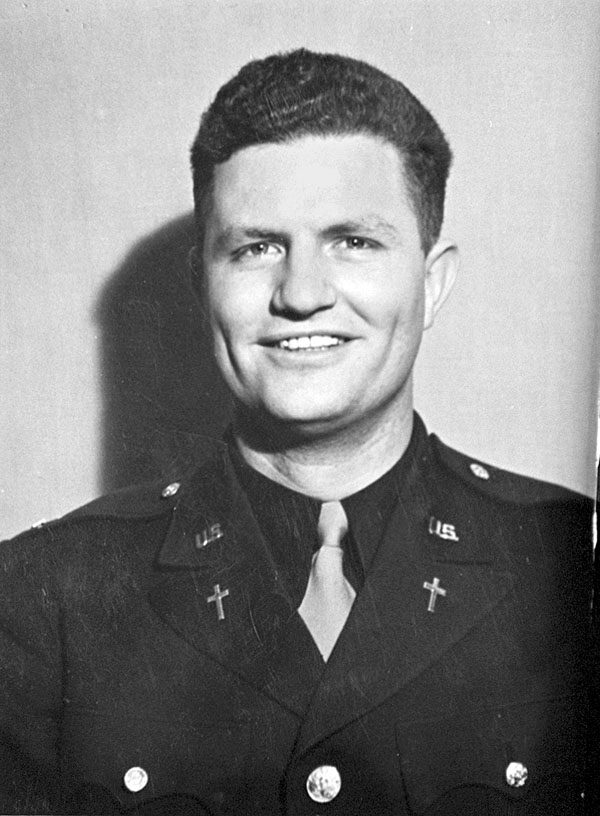
Captain Paul M. Stevens
A Chaplains Story
|
|
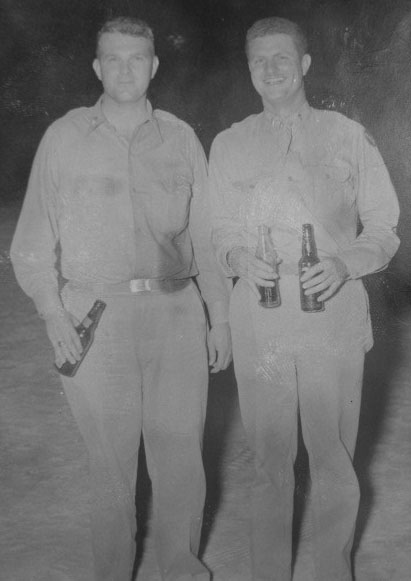
Relaxing with the dentist, Lt. Hunt
|
During Word War II, I was a chaplain to the 450th Bomb Group, 720th Squadron,
flying four engine Liberator bombers from near Manduria in soothern Italy.
One of my assignments was gathering, inspecting and eventually mailing home the
personal effects of airmen who had been shot down or were missing in action.
Another was to be the morale officer. But the airmen's schedules were so
crammed and rigid that is was difficult to have enough time to get to know
them.
Briefing for the day's mission took place in the war room at 2:30 a.m., three,
four or sometimes seven days a week. The briefings were usually very tense,
with life-and-death information the daily menu.
There was little time for the chaplain.
Take offs were generally about 5 a.m. Formation for the mission could take an
hour or more; by the time that the fliers returned to the base, they were
exhausted.
The first thing that they received on their return was their "shots" to help
quiet their nerves, especially if the mission had suffered great losses.
After a debriefing, they had dinner, leaving my visiting time to be hit-or-miss
calls in their tents between 7 and 8:30 p.m.
At the end of each mission, as the planes returned, I parked my jeep so I was
facing them as they landed. All I could do was wave as they came in, but they
knew I was there.
Most of the planes had names or paintings -- nose art, as it was called --on
them. I counted them as they landed, as a shepherd counts his returning sheep.
One afternoon, as I stood by my jeep waving, I noticed a couple of the planes
circling the airfield at about 1,000 feet. That meant trouble.
Suddenly a jeep raced up and the driver yelled, "The C.O. wants you in the
tower."
As I stepped into the tower, the commanding officer motioned me to his side. He
told me that there were wounded men on one of the planes and that the mechanism
that lifted the belly turret back into the plane had been shot away. The plane
had lost its hydraulic systems.
"There is about five minutes of gas, and the plane will then have to belly
land," I recall his saying. "The gunner in that turret cannot be saved. He is
aware of the situation and wants to talk with you."
The colonel then turned the microphone on and told the airmen, "Chaplain
Stevens is here. I'll give him the mike."
What happened next still moves me almost to tears to this day.
"Robertson" -- I do not use his real name because of his last request -- told
me that he was aware he was about to die. He wanted to thank everyone -- those
in the plane with him and in the tower -- for what they tried to do to save
him.
"Please don't tell my parents how I died," he said. "Pray for me."
I prayed with my eyes on the plane.
What I said to my God, I do not know. But at the last minute I turned my mike
off, and there was Robertson's voice, reciting the Lord's Prayer.
As I watched that plane drop the last few feet, I heard him say: "Thy kingdom
come, thy will be done."
And then the plane hit the ground, and the turret disappeared in a streak of
sparks.
A 1990 film, Memphis Belle, recounted a similar story. I have never seen the
movie. I don't want to because, I am sorry to say, I witnessed the real event.
Each year at the reunion of the 450th Bomb Group, I speak at the memorial and
worship services. Some of the men had heard me recount this story; a couple of
years ago, they asked me to tell it again.
When I finished, there were few dry eyes in the room.
Afterward, one of the men made his way to me.
"I was in that plane," he said. "We tried and tried to get that turret up and
could not. All through the years, I have suddenly remembered that event,
started crying and have never been able to tell anyone why."
I understand the feeling, for it is one I share each time I am reminded of
aerial combat.
I collected Robertson's personal effects and sent them to his parents, along
with a letter telling them that he bravely died serving his country.
They never knew just how brave he really was.
|
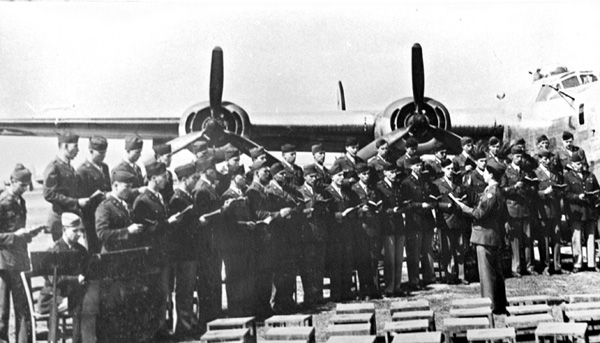
Choir Practice 1944
|
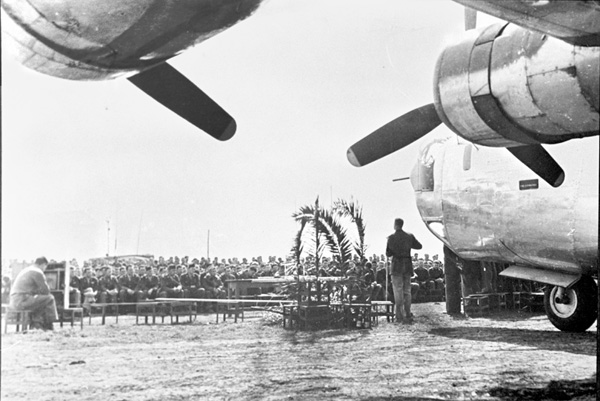
Easter Service 1944
|
TEN DAYS AT ANZIO
As the Allies marched north in Italy in 1943, the
Germans simultaneously launched a full-bore attack on the American forces. The monastery of San Pietro anchored their
rear so effectively that the Allies could not break through.
The Allies determined to invade Italy north of the
German lines and march east to cut Italy in half and attack the Germans from
their rear.
With the greatest secrecy the invasion was launched
at Anzio on the west coast of Italy. The Germans sensed that repelling the Allies was a life or death
situation for them and the battle rose to a high pitch. All resources of the air and ground were
quickly brought to bear to bring the invasion to a successful conclusion.
The 15th Air Force Chaplaincy, under
whose command I was serving, called on many of the chaplains to aid the
invading Americans. I was one of those chaplains.
Times and dates fail me now, as I have tried,
through the years, to shut out those ten days. I served, for the most part, in what the medics called "triage" – a
group of men and women (nurses) who examined the wounded as they arrived to
determine the extent of their injuries. They were then separated into two groups; those who had a chance to
survive or those who were so badly injured there was little or no hope for
them.
The pressure was so intense as the stream of badly
wounded soldiers grew larger by the hour. I had never seen, nor have I since, so large a group of professionals
work so hard under such pressure. No
one took time for anything –not to bath, shave, wash hands, or change
clothes. Nurses, officers and enlisted
men alike worked around the clock, knee-deep in blood and bandages, amid
weeping wounded fellow Americans.
On or about the tenth day, as I remember it, we were
replaced "en mass" and all of us were taken to the coast where a great ship was
anchored. I was told it was the former
luxury liner, The Europa.
Upon climbing aboard, I was spotted almost
immediately by the Captain who saw the cross on my blouse and realized I was a
chaplain. He quickly fell in beside me
and said, "Chaplain, we have not had divine services on our ship for three
months. Would you please be willing,
after you have had a chance to eat, clean up and get some sleep, to conduct a
service for us?"
He gave me twelve hours to try to become "human"
again. As I awakened there was a knock
on my door and I opened it to find a college classmate standing there with a
grin from ear to ear. He had heard the
Captain announce over the loud speaker that "Chaplain Paul Stevens would
conduct divine services at 10:00 hundred hours on the fantail of the ship,"
which I did.
I was then sent to Naples and was put up at the
Albergo (hotel) to begin the process of trying to heal my spirit, after the
most shocking and difficult experience of my young life.
|
Stories submitted by Betty Stevens, Alice and Doid Raab, Pictures submitted by David Hill
|